






Supporting Diverse Learners to Succeed
Magrid helps learners with diverse and special educational needs engage and succeed by focusing on what they can do. Its structured, visual approach builds confidence, independence, and the core skills that underpin all learning.
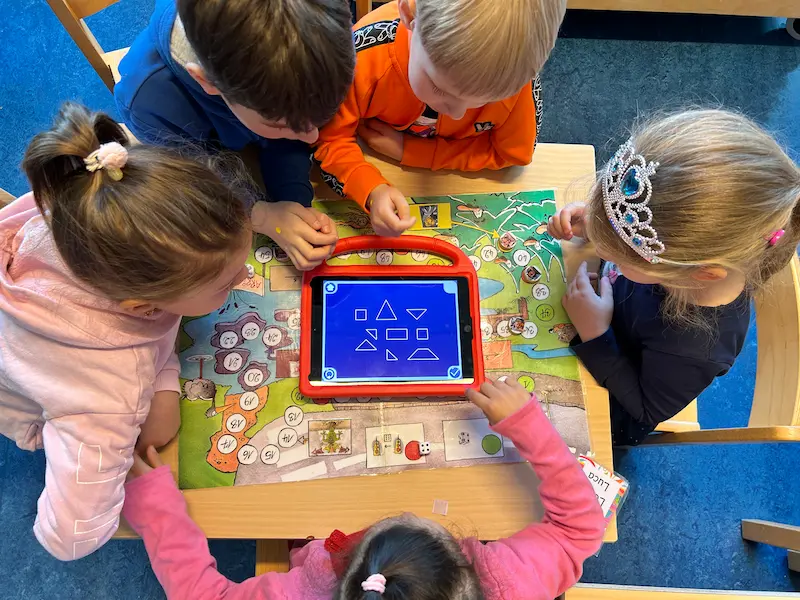
A strengths-based approach to learning
Magrid is built around a simple idea: learning should begin with capability, not limitation.
Children engage with activities that are accessible from the start, allowing them to experience success early and build confidence as they progress. This helps to reduce frustration, increase motivation, and support more positive learning behaviours.
By focusing on what learners can do, Magrid supports the development of:
- confidence and independence
- sustained attention and engagement
- willingness to explore and solve problems
This approach aligns with modern special education practices, where the goal is not only to support learning needs, but to unlock each learner’s potential.
How Magrid supports diverse learners
Magrid removes common barriers to learning, making it easier for learners with diverse and special educational needs to engage, progress, and succeed.

Accessible by design
Magrid’s core design ensures that learners can access activities independently from the start:
- Language-neutral, visual activities – no reading required
- Clear, consistent task design – supports understanding and focus
- Low-stimulation environment – reduces cognitive overload
- Independent interaction – learners can work without constant instruction

Supportive by structure
Magrid’s learning model helps learners build understanding step by step:
- Structured progression – concepts are introduced gradually
- Scaffolded tasks – support is built into each activity
- Repetition with variation – reinforces learning in different ways
- Adaptive pathways – learners progress at their own pace
This approach allows learners to engage directly with concepts, rather than relying on verbal explanations or written instructions, supporting more meaningful and inclusive participation.
The skills that unlock learning
Magrid develops the foundational cognitive and motor skills that underpin learning across subjects.
These include:
- visual perception
- working memory
- spatial reasoning (including mental rotation and folding)
- pattern recognition
- hand–eye coordination and fine motor control
These skills are essential for:
- early literacy (recognising letters, writing, tracking text)
- mathematics (understanding quantity, patterns, and relationships)
- problem solving and reasoning
By strengthening these underlying abilities, Magrid helps learners build the capacity to access and succeed in a wide range of learning tasks.
Supporting a wide range of learning needs
Magrid can be used effectively with learners who:
- benefit from structured, step-by-step learning
- have low literacy or limited language proficiency
- require additional support with attention, memory, or processing
- thrive with visual and interactive learning
This includes learners with diverse profiles, such as those with:
- Autism
- Dyscalculia
- Dyspraxia
- ADHD
Magrid does not target specific diagnoses, but provides a learning environment that supports a wide range of needs in a consistent and accessible way.

Building independence and engagement
One of Magrid’s key strengths is its ability to support independent learning.
As the tasks are visual and intuitive, learners can engage without needing continuous instruction or explanation. This allows them to:
- work at their own pace
- repeat and explore concepts
- build confidence through success
For professionals, this creates opportunities to:
- observe learning more closely
- provide targeted support when needed
- reduce reliance on constant one-to-one guidance
Insight that supports observation and intervention
Magrid helps make learning visible in a clear and practical way, giving professionals meaningful insight into how learners engage with different skills over time.
Through regular use, it provides detailed, skill-level information across both training and assessment, highlighting patterns in progress, strengths, and areas where additional support may be needed.
While Magrid is not a diagnostic tool, the data it generates can:
- support early identification of learning differences
- inform professional judgement and intervention strategies
- contribute to a broader evidence base for assessment and support planning
Over time, this builds a rich, continuous picture of development, offering a more natural and accessible complement to formal assessments.
This makes it easier to document progress, support discussions with families and specialists, and build a clearer understanding of each learner’s strengths and support needs.
Working alongside support plans and interventions
Magrid is designed to complement existing approaches, including:
- individual education plans (IEPs)
- targeted intervention programs
- specialist support and therapy
It can be used in:
- one-to-one sessions
- small-group interventions
- inclusive classroom settings
The program’s structured and consistent design allows it to be easily integrated into existing support frameworks without adding complexity.
Supporting collaboration across your team
Magrid helps create a shared understanding of learning across teachers, specialists, and support staff.
Progress is visible and structured, making it easier to:
- share insights between classroom teachers and specialists
- align on learner needs and next steps
- support consistent strategies across different learning environments
Student data can be easily accessed and shared across your team, allowing both teachers and specialists to monitor progress and contribute to support planning.
Learners can also access their profile across different settings, making it simple to use Magrid in both classroom and specialist environments without disruption.
This enables more effective collaboration, ensuring that support is coordinated, consistent, and aligned with each learner’s development.
A different approach to learning
Magrid offers a different way of thinking about learning support.
By focusing on accessibility, independence, and capability, it helps learners engage with learning in a positive and meaningful way.
This supports not only skill development, but also confidence, motivation, and a stronger sense of achievement.
Supporting every learner to succeed
Magrid helps professionals create learning environments where every learner has the opportunity to engage, progress, and succeed.