




Mais de 60 000 alunos em todo o mundo confiam em nós

MAGRID for Early Learners

For children in pre-kindergarten, preschool, or nursery  

(ages 3 and 4, varies internationally, typically prior to compulsory schooling).

Developmental Abilities in Early Childhood (Ages 3 and 4)

By age three to four, children are rapidly gaining independence in everyday routines, beginning to take more control over their own self-care and daily tasks. Socially, they begin to show more interest in playing with peers, taking turns, and using language to share needs and emotions. Cognitively, this period marks the start of powerful growth: children can follow two- to three-step instructions, sort objects by simple features, recognize and name basic shapes and colors, and begin to understand concepts of quantity through matching, subitizing, and early counting. They also engage in more symbolic play, showing they can use imagination to represent real-world experiences. Research in developmental psychology (e.g., Piaget’s preoperational stage, Vygotsky’s emphasis on language and scaffolding) highlights these years as foundational for building attention, memory, and problem-solving skills that prepare children for the transition to formal learning.

Why is Magrid Ideal for Ages 3 and 4?

Examples of Early Years Tasks in Magrid (Ages 3 and 4)

With over +1,000 tasks specifically designed for pre-kindergarten learners, here’s a glimpse at some specific examples in action.

1. Odd one out

This task presents a set of simple shapes and asks the child to identify which one is different. Although it may appear straightforward, this activity engages critical cognitive processes: children are exercising visual differentiation, developing early classification skills, and strengthening working memory as they compare features across items. Such tasks lay the groundwork for higher-order reasoning by fostering attention control and symbolic thought, building the neural and cognitive structures that support learning even before children can articulate their thinking in language.

2. Close the shape

The hand-eye coordination task of “close the shape” activity presents children with a nearly complete figure, such as a triangle with one side missing, and asks them to draw the final line. Once again, a seemingly simple task is doing big work in the child’s brain: they must recognize the incomplete form, hold the full template in mind, and guide their hand to connect the correct points with control and accuracy. In doing so, they are strengthening visual–motor integration, spatial awareness, and the early building blocks of geometric reasoning. Something as straightforward as drawing a single line is in fact a powerful way to prepare children for more complex drawing, writing, and mathematical tasks.

3. Select the quantity

In the “Select the Quantity” activity, children see a group of objects—like apples or oranges, and choose the matching number. Tasks begin with small quantities (1–5) and grow more challenging, asking children to find specific numerals out of order, or count larger amounts. Guided tutorials and supportive feedback help children succeed as they practice counting, number recognition, and understanding that numerals represent real quantities. Through regular, repeated play, children build confidence in early numeracy, a key element for school readiness and future math learning.

4. Quantity house

The “quantity house” activity shows a small group of objects, such as three cats, and asks the child to place the same number of cats into a house below. At first glance it seems like simple picture matching, but it’s actually the very beginning of numerical understanding: children are practicing one-to-one correspondence, using visual skills to align sets, and sometimes even subitizing small quantities without counting. This most basic step lays the foundation for recognizing that numbers represent amounts, long before formal counting begins.
Additional Visual–Spatial Tasks for Early Learners

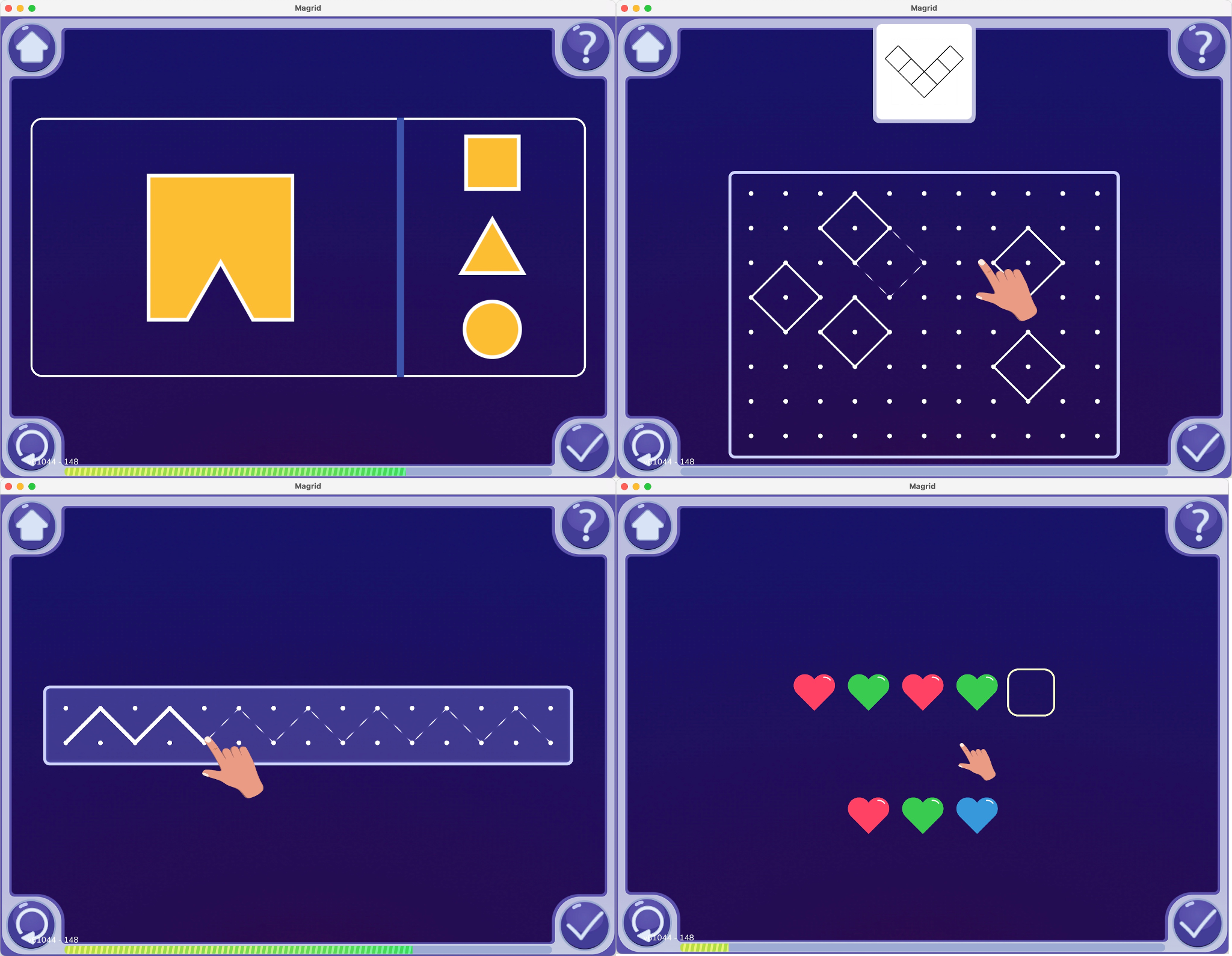
Magrid also includes a broad set of visual–spatial activities, ranging from early geometry and pattern recognition to hand–eye coordination and other visual perception tasks. These activities not only strengthen spatial awareness but also build the cognitive flexibility and visual reasoning skills that support later success in mathematics, reading, and problem-solving. Thanks to the scaffolded design of Magrid tasks, and the intuitive interface, even tasks intended for slightly older children — such as mental rotation, mental folding, and working memory exercises — are successfully completed by younger learners.

Early Numerical Tasks in Magrid

For 3 and 4 year old children who are ready to explore numbers, Magrid offers a wide range of entry-level numerical activities. Building on the quantity activity, tasks gradually introduce number recognition — both by seeing the digit and hearing it spoken (currently available in eight languages). Children also engage in quantity recognition and matching activities, as well as the first steps of ordinality, arranging and sorting small numbers in sequence.

The Impact of Magrid: What the Research Shows

Across a series of six studies carried out between 2015 and 2021, researchers have found that the Magrid program consistently helps young children strengthen key building blocks for mathematical learning. These include improvements in visual–spatial reasoning (understanding and manipulating shapes and space), visuomotor integration (coordinating what they see with how they move), and early numerical skills such as counting, comparing quantities, and recognizing patterns.

The studies show that Magrid’s digital activities are not just engaging; they are also scientifically validated. Children who used Magrid in small-group or classroom settings showed more progress in foundational spatial and number concepts compared to peers who followed standard lessons. The research also found that these improvements appear in real classroom environments, not only in research labs, which suggests that Magrid fits naturally into everyday teaching and learning routines.

Overall, the Magrid studies provide strong evidence that interactive language-free learning tools can give all children, no matter their language background, an equal opportunity to build the early mathematical and cognitive understandings that will support their future learning in school and beyond.

Using Magrid in the Classroom (For Teachers of 3 and 4 Year Olds)

Magrid is not only developmentally appropriate for early learners — it is also flexible enough to fit naturally into daily preschool/pre-kindergarten/nursery school routines. Educators can use it in short, focused sessions or as part of targeted learning support.

Using Magrid at Home (For Parents of 3 and 4 Year Olds)

Whether your child is not yet in school, learning at home, or you simply want extra support and engagement, Magrid can be a playful way to build early learning skills.

How Magrid Can Support Early Learners with Special Needs

MaGrid’s inclusive approach ensures that children of all abilities can participate and succeed. It supports both neurotypical and neurodiverse learners in the classroom and at home, fostering a sense of inclusivity and belonging. Although not a diagnostic tool, Magrid complements early intervention efforts, helping teachers understand each child’s progress and giving parents a simple, low-stress way to encourage meaningful learning.

Inclusive Aspects of Magrid

Magrid is inclusive by both design and content, ensuring that every child, regardless of ability, background, or learning profile, can engage meaningfully and make progress.

Inclusive by Design

MaGrid’s accessibility starts with design decisions that are scientifically informed and research-based to support diverse learners. Key features include:

  • A low-stimulation visual environment with minimal distractions, supporting children who may experience attention or sensory challenges.
  • Clear, scaffolded tasks and strong visual cues that guide children step-by-step, making it easier to focus and succeed independently.
  • A balanced feedback system, as well as carefully chosen sounds, colors, and light contrasts, that provide encouragement without overstimulation.
  • Left- and right-hand differentiation, promoting comfort and usability for all learners.
  • A language- and culture-free interface, ensuring that activities are accessible to children of any linguistic background or literacy level.

Inclusive by Content

Beyond design, Magrid’s content has been developed to address the needs of children with different developmental profiles. The curriculum integrates tasks from cognitive science and early education research to support varied areas of growth. These include:

  • Cognitive training tasks that strengthen attention, memory, and visual–spatial reasoning.
  • Adaptive progression that allows children to learn at their own pace and repeat activities as needed, building confidence through success.
  • Atividades não verbais e destinadas a pessoas com baixos níveis de literacia that remove linguistic barriers while nurturing foundational numeracy and problem-solving skills.

This thoughtful combination of accessible design and differentiated content ensures that Magrid remains truly inclusive, supporting every child to develop essential early learning skills in a calm, structured, and empowering environment.

Curriculum Alignment

The mathematical and cognitive skills developed in Magrid align closely with early learning curricula used in many education systems around the world. Core areas such as counting, cardinality, number operations and geometry reflect the same foundational goals outlined in international frameworks for early childhood and primary education.

Magrid’s team has already mapped the program to several widely used curricula as examples, demonstrating how its activities correspond to recognized learning outcomes and developmental milestones. In addition, curriculum mapping for your specific school, district, or national framework can easily be created by the Magrid staff to ensure a seamless integration into your local context.

Further examples and detailed comparisons are available on the Curriculum page, where educators can explore how Magrid supports curriculum standards and complements existing teaching approaches.

Magrid: Building the Foundations of Lifelong Learning

Magrid holds a special place in the education technology landscape by offering something few tools truly achieve: a research-backed, developmentally appropriate program that meets children right at the beginning of their learning journey. At ages 3 and 4, when attention spans are short, literacy is emerging, and learning is still deeply rooted in play and exploration, Magrid provides high-quality tasks that are simple, engaging, and accessible to every child. From visual–spatial reasoning to early numeracy, from hand–eye coordination to classification, its scaffolded design allows children to succeed at their own pace, whether they are neurotypical or neurodiverse, pre-verbal, pre-literate, or simply not yet ready for formal schooling.

For teachers, Magrid is a flexible classroom tool that supports independent learning, targeted intervention, and even early observations of children who may benefit from additional support. For parents, it offers a safe, purposeful, and enjoyable way to engage children at home, aligned with global recommendations for screen time and early learning.

In a field where many edtech products focus either on older children or on flashy distractions, games, Magrid stands out for its focus on quality, inclusivity, and developmental appropriateness. It is more than just a set of digital tasks — it is a bridge between play and formal learning, helping the youngest learners build the confidence, skills, and curiosity that will carry them into school and beyond.

Impacto

Whether your child is not yet in school, learning at home, or you simply want extra support and engagement, Magrid can be a playful way to build early learning skills.

Visual assessment improvment

Short and balanced: 10–15 minutes a day is plenty, keeping within W.H.O. guidelines for screen time at this age.

Mathematical skills improvment

Magrid is designed to work well supporting both neurotypical and neurodiverse learners (including children with additional support needs), offering a flexible way to practice and grow at their own pace.

Magrid for 3 to 4 years

Tasks are designed around early childhood learning stages, with visual, concrete challenges rather than abstract demands.