


A nossa jornada
“Equal, Accessible, and Inclusive Learning for All Children Worldwide.”
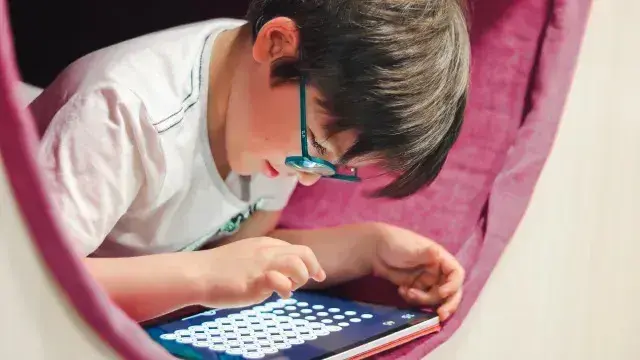
From research to global impact
Magrid began in 2014 as a research initiative in Luxembourg, developed in the University of Luxembourg in collaboration with the Ministry of Education of Luxembourg and Luxembourg National Research Fund.
From the beginning, the goal was clear: to create a learning solution that could make early mathematics accessible to all children, regardless of language, background, or learning profile.
The early years focused on research, development, testing, and validation. A multidisciplinary team of experts in education, psychology, and neuroscience worked together to design a structured, language-free approach to learning. Through extensive research, development and testing in real classrooms, the program was refined and validated to ensure both scientific rigor and practical effectiveness.
A problem worth solving
Behind this research was a simple but powerful question:
How can learning be made truly accessible for every child?
For Magrid’s founder, Dr. Tahereh Pazouki, this question was deeply personal.
As a child, she supported her younger brother through learning challenges caused by long periods away from school. Watching him struggle—and then succeed—shaped her understanding of how powerful the right learning support can be.
That early experience became the foundation for her academic and professional path, leading her to pursue studies in computer science and psychology, and ultimately a PhD focused on children’s learning and development .
From research to real-world application
Between 2015 and 2019, Magrid evolved into a fully developed, non-verbal learning program designed to support both mathematical and cognitive skill development.
Classroom studies demonstrated consistent improvements in children’s learning outcomes across diverse groups, including multilingual learners and those with additional educational needs.
In 2020, following successful validation, Magrid received official approval from the Luxembourg Ministry of Education and in March 2021 Magrid was rolled out across all public schools nationwide. This marked a key transition from research project to system-level implementation.
Building a mission-driven company
Following this milestone, Magrid was formally established as a company in Luxembourg.
The vision expanded from research to impact: to make the program accessible beyond a single country and to support children globally.
With a strong scientific foundation and a clear mission, Magrid began working with schools, inclusive education centres, and institutions to deliver structured learning supported by training, data insight, and ongoing support.
Strengthening the mission through shared values
As Magrid continued to grow, it began attracting supporters who deeply understood the importance of inclusive education and equal access to learning.
One of the earliest was Prince Louis of Luxembourg. Following an introduction through the Luxembourg–Portugal Economic Forum, Magrid was presented to Prince Louis and later to Her Royal Highness Grand Duchess Maria Teresa of Luxembourg. The vision behind Magrid immediately resonated, particularly its focus on neurodiverse learners.
With extensive experience and advocacy in special educational needs, learning disabilities, and dyslexia, Prince Louis recognised the importance of creating learning environments that work for all children. He first joined Magrid as an investor, and later became an advisor and ambassador for the program.
Today, as Head of Neurodiversity, his involvement continues to strengthen Magrid’s mission, helping expand partnerships, increase awareness, and ensure inclusion remains central to the program’s development.
Growing with purpose
Magrid’s international expansion has been deliberate and measured.
Rather than scaling rapidly, the focus has been on:
- maintaining quality of implementation
- adapting to different educational contexts
- continuous testing and validation
- developing new content and language support
- building strong local partnerships
This approach has allowed Magrid to grow sustainably while ensuring meaningful impact in each new context.
Today, Magrid is used across more than 15 countries, in Europe, North and Latin America, the Middle East, and Asia, supporting children in diverse educational systems and environments.
A global team with a shared mission
By 2026, Magrid has grown into a global team of more than 30 professionals, working across research, education, technology, and implementation.
The program is now implemented in collaboration with governments, schools, universities, institutions, and foundations worldwide. Magrid supports early learning for all learners, including both neurotypical and neurodiverse children, across local and national education systems. It is used in a wide range of settings, from high-end schools and specialised education centres to rural and remote communities.
Continuous research and development remains central to Magrid’s approach. The program evolves through quantitative and qualitative research:
- continues research and validation studies
- Qualitative focused groups with teacher and user surveys feedback
- data-driven analytical monitoring and refinement
This ensures that Magrid continues to be a scientifically validated solution with high standards to meet the needs of real classrooms and real learners.
Looking ahead
Magrid’s journey reflects the combination of research, purpose, and real-world application.
What began as a research question has become a global learning solution, supporting children, educators, and education systems in building strong foundations for the future.
At its core, the mission remains unchanged:
To make high-quality education accessible, inclusive, and equitable for every child, everywhere.