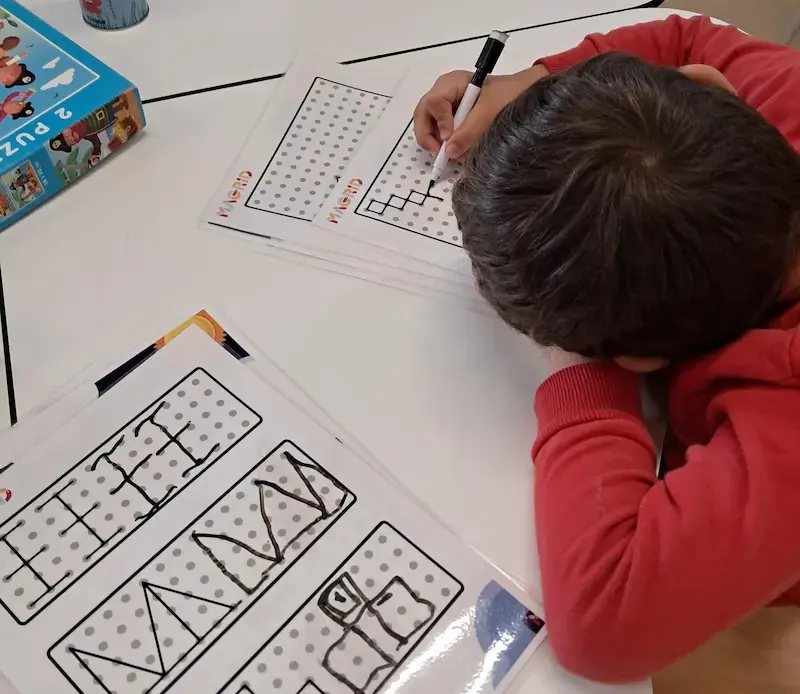







Respuesta rápida: Autism spectrum disorder (ASD) mainly affects social communication, sensory processing, and behavior, while dyslexia is a specific learning disorder that affects reading, word recognition, and phonological processing. Both are neurodevelopmental conditions that can appear in early childhood, sometimes overlap, and both benefit from early detection and visual, language-independent learning tools such as Magrid.
Autism vs Dyslexia at a Glance
| Autism Spectrum Disorder (ASD) | Dislexia | |
|---|---|---|
| Main area affected | Social communication, behavior, sensory processing | Reading, spelling, phonological processing |
| Typical early signs | Delayed language, limited eye contact, repetitive behaviors | Difficulty decoding words, slow reading progress |
| Social interaction | Often significantly affected | Usually not directly affected |
| Sensory sensitivities | Common (sound, light, texture) | Rare, though anxiety around reading is common |
| Diagnosis typically involves | Developmental pediatrician, psychologist, speech therapist | Educational psychologist or reading specialist |
| Core support strategies | Speech therapy, behavioral therapy, sensory-friendly environments | Structured reading programs, occupational therapy, visual aids |
| Can co-occur? | Yes, some children show traits of both | Yes |
¿Qué es el trastorno del espectro autista?
Autism spectrum disorder (ASD) is a neurodevelopmental condition affecting social interaction, communication, and behavior. Autistic children may show delayed language acquisition, repetitive behaviors, and difficulty interpreting social cues. Sensory sensitivities, to sound, light, or texture, are also common and can make everyday classroom environments overwhelming.
Because ASD is a spectrum, severity varies widely from child to child. Early, comprehensive evaluation by a multidisciplinary team (developmental pediatrician, psychologist, speech therapist) allows for interventions such as speech and behavioral therapy, which improve communication and social engagement.
What Is Dyslexia?
Dislexia is a specific learning disorder rooted in phonological processing, the ability to connect sounds to letters. Children with dyslexia often struggle to decode words, recognize them by sight, and build reading fluency, which in turn affects reading comprehension and writing.
Unlike ASD, dyslexia does not typically affect social interaction directly, though repeated academic struggle can lower a child’s confidence and self-esteem over time. Diagnosis usually comes from an educational psychologist or reading specialist once a child starts encountering reading instruction at school.

Where Autism and Dyslexia Overlap
Despite affecting different areas of development, the two conditions share some practical overlaps:
- Both can involve delayed early language development.
- Both benefit enormously from early detection and early intervention.
- Both can include sensory or attention-related challenges that make a standard, text-heavy classroom harder to navigate.
- Both can co-occur in the same child, which is why a broad, individualized evaluation matters more than looking for a single label.
Where They Differ
The clearest dividing line is what each condition affects first:
- Social communication: central to autism, largely untouched in dyslexia.
- Reading and language processing: the defining feature of dyslexia, not a core feature of autism.
- Repetitive behaviors and sensory overload: common in autism, uncommon in dyslexia.
- Academic impact: dyslexia’s challenges are concentrated in reading and writing; autism’s challenges are broader, touching communication, routine, and social learning.

Early Detection Matters, for Both
Whether a child shows signs of autism, dyslexia, or both, the same principle applies: the earlier a difference is identified, the more effective the support. Delayed language, difficulty with reading readiness, or strong sensory reactions are all reasons to loop in a pediatrician or school specialist rather than “wait and see.”

How Magrid Supports Children With Autism, Dyslexia, and Other Learning Differences
Most early-math tools assume every child reads and processes language the same way, which is exactly where children with autism, dyslexia, ADHD, or dyscalculia get left behind. Magrid was built differently.
- 100% visual, no reading required. Magrid teaches math through visual and tactile activities with no written or spoken instructions, removing the language barrier that trips up many dyslexic and multilingual children.
- Designed for sensory needs. The interface adapts difficulty to each child’s pace and is built to reduce sensory overload, a direct answer to the sensitivities common in autism.
- Backed by research, not guesswork. Magrid grew out of over a decade of cognitive science research at the University of Luxembourg and has been validated in school trials across multiple countries.
- Real scale. Over 60,000 students and 42,000 families currently use Magrid worldwide, including in national school rollouts (Luxembourg) and inclusive-education pilots.
If your child shows signs of autism, dyslexia, or simply learns differently, a language-free approach to early math can remove one major source of daily frustration, for the child and for you.
Try a free Magrid demo →
See how Magrid supports neurodiverse learners →
Cómo afrontar los retos del autismo y la dislexia
Both autism and dyslexia bring real challenges, but early detection and the right support make a lasting difference. Autism mainly affects social communication and sensory processing, while dyslexia centers on reading and language processing, and understanding that distinction is the first step to getting a child the right kind of help. With tailored support from parents, educators, and specialists, and tools built for how each child actually learns, children with autism, dyslexia, or both can build confidence and thrive.